Body / Machine: Three Signals Redesigning the Human Interface
IN GOOD FORM / 008
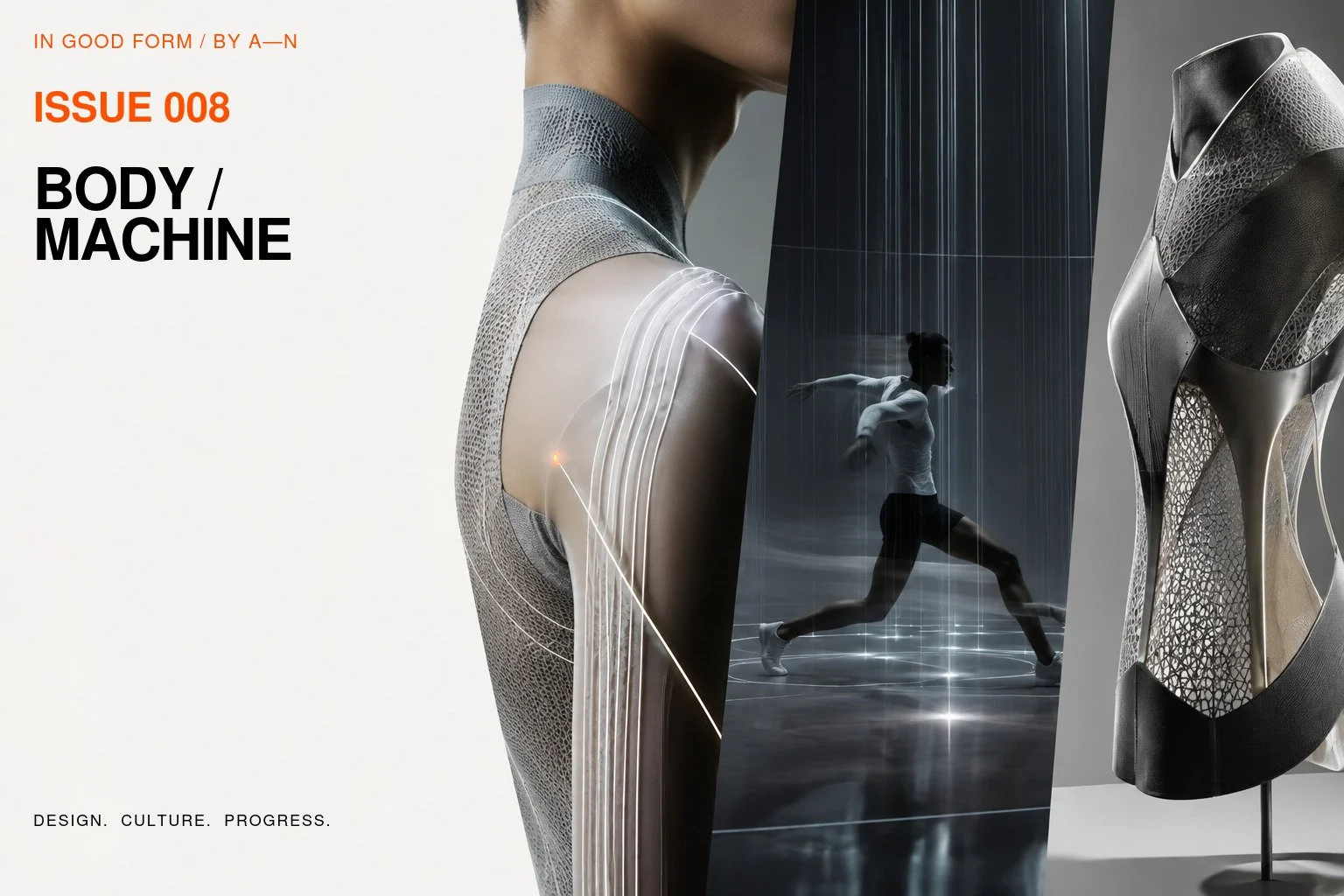
Three things we are watching across design, culture and experience — and the connective tissue between them.
The body is becoming the primary interface. Architecture curves around it. Images learn to move like it. Technology leaves the screen and enters the things we wear. The question is no longer whether physical and digital will merge, but what kind of human experience that merge will produce.
Lead artwork: A—N.
01 / NEW OPENING — SKIMS REGENT STREET
SKIMS’ first standalone UK store translates the brand’s body logic into 12,000 square feet on Regent Street. Designed by Rafael de Cárdenas, the flagship uses pale continuous surfaces, radiused corners and two large curved gestures to create an impression of softness without turning every wall into a curve.
A monumental Vanessa Beecroft sculpture presides over the interior, giving the body the authority of architecture. Fitting rooms are both intimate chambers and miniature production studios, calibrated for the contemporary act of photographing oneself. A proprietary scent operates below conscious recognition, warming the monochrome environment.
The signal: atmosphere is a system of small permissions. The space succeeds when it lets a customer feel private and foregrounded, comfortable and powerful, without forcing them to notice the mechanics.
Project: SKIMS Regent Street, London. Architecture: Rafael de Cárdenas. Sculpture: Vanessa Beecroft. Image credit in the source: SKIMS; exterior rendering courtesy Rafael de Cárdenas. Source: Wallpaper*, published 7 August 2026 — https://www.wallpaper.com/fashion-beauty/kim-kardashian-interview-skims-architecture-london-store-rafael-de-cardenas
02 / CULTURE — MOMA: IT’S ALIVE!
It’s Alive! A Century of Animation from the Collection opens MoMA’s archive across more than 100 years of moving-image invention. The exhibition gathers work by more than 35 artists and filmmakers, from silent-era character animation through hand-drawn experimentation, television, MTV and predigital independent practice.
Animation is a useful cultural lens because it has always turned technology into gesture. A line becomes a body. A sequence becomes emotion. Tools change, but the medium remains obsessed with making the inanimate feel present.
The signal: the future is often understood through movement before it is understood through language. Spatial identity will increasingly behave like animation — responsive, sequential and capable of shifting across time rather than remaining one fixed composition.
Exhibition: It’s Alive! A Century of Animation from the Collection, MoMA, 1 August 2026–summer 2027. Organised by Ron Magliozzi, Francisco Valente, Katie Trainor and Cara Shatzman. Lead work on the official page: Buzzco Productions/Buzzco Associates, MTV cel setup: Astronauts, c. 1983; collection credit MoMA. Source: MoMA — https://www.moma.org/calendar/exhibitions/5920
03 / EXPERIENCE — META LAB CHICAGO
Meta has announced its first Midwest Meta Lab for Chicago’s Gold Coast, expected before the 2026 holiday season. The format brings AI-enhanced Ray-Ban and Oakley glasses, open-ear audio and virtual-reality hardware into a physical setting built around trial, explanation and local cultural relevance.
Wearable AI creates a particular retail challenge: the product only makes sense once it is on the body. Specification is not enough. Customers need to test how it sees, hears, records and responds — and to understand the privacy implications of a device that makes the camera ambient.
The signal: technology retail is becoming onboarding architecture. The store’s role is to make an unfamiliar behaviour legible, socially acceptable and trustworthy. Experience design must demonstrate capability and establish boundaries at the same time.
Project: Meta Lab Chicago, announced for 932 N. Rush Street. Meta product imagery and project details remain credited to Meta in the reporting source. Source: Axios Chicago, published 12 August 2026 — https://www.axios.com/local/chicago/2026/08/12/meta-lab-store-new-chicago-gold-coast-first-midwest
THE A—N READ
The body is not another touchpoint. It is the point around which everything else is reorganising.
SKIMS makes architecture bodily. MoMA shows how image learns to move. Meta asks technology to sit directly on the face. Together they raise a more important design brief than visual futurism: how should an environment protect agency while expanding possibility?
The future will not feel intelligent because it contains more devices. It will feel intelligent when technology understands the scale, vulnerability and power of the person using it.
What should the interface make more human?